A print made from darkness
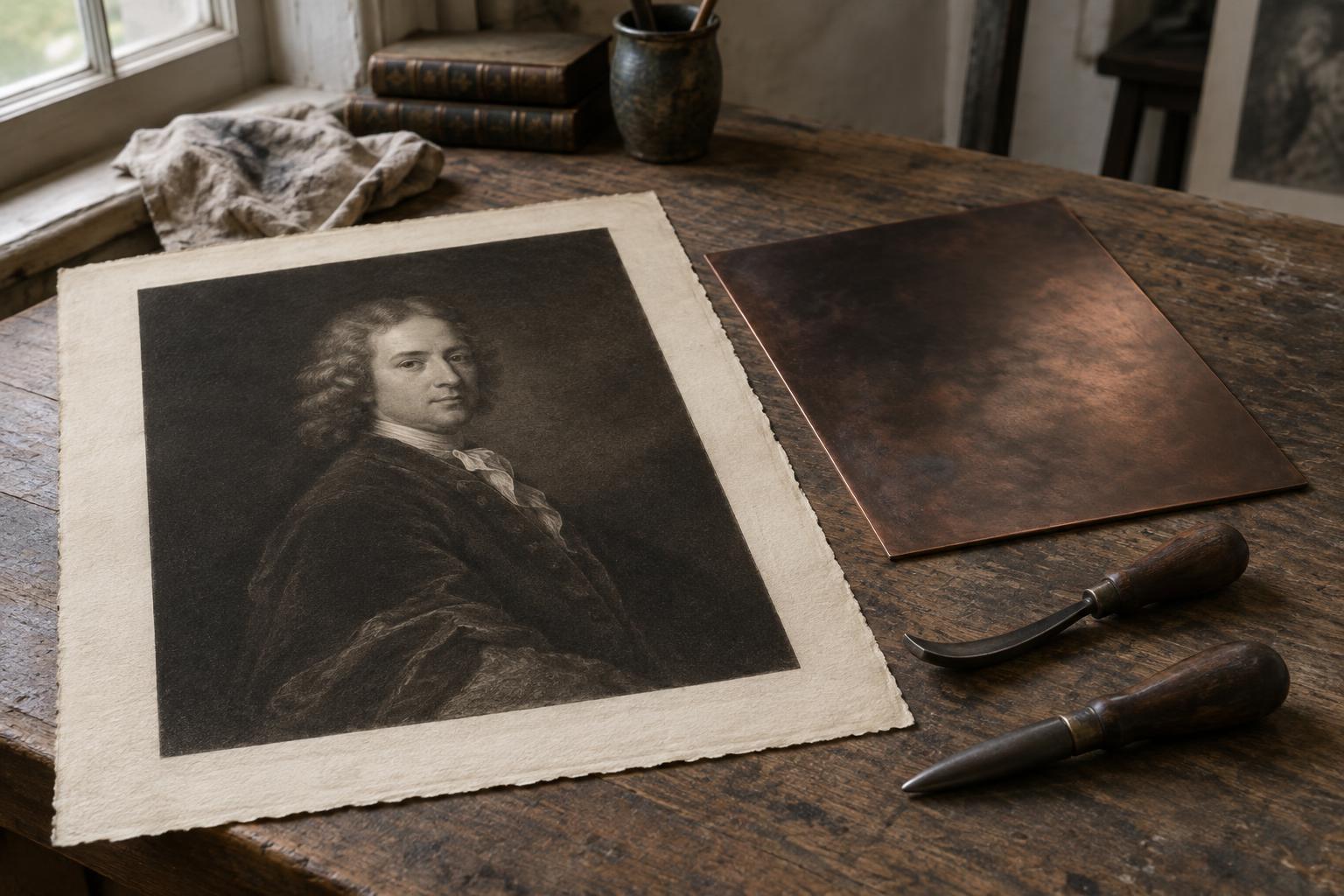
Most intaglio printmaking begins with marks cut into a relatively smooth metal plate. Mezzotint reverses that logic. The printmaker roughens a copper plate across its surface so that, if inked and printed at this stage, it would produce a dense, dark field. They then smooth selected areas with a scraper or burnisher. Smoother metal holds less ink, creating lighter tones on the paper. The image emerges by working from dark toward light.
This approach gives mezzotint its distinctive range of soft transitions and deep, velvety shadows. Rather than relying primarily on visible lines to describe a face, a printmaker can build rounded cheeks, reflective eyes, folds of fabric and the gradual fall of light across a background. A mezzotint is not simply a painting transferred to paper: every tone has to be interpreted through the preparation and smoothing of the plate.
From experiment to portrait trade
Mezzotint emerged in Europe in the seventeenth century; Ludwig von Siegen is commonly credited with its earliest known examples. The process became especially important in Britain, where printmakers, painters and publishers developed a substantial trade in portrait prints. By the eighteenth century, mezzotint was a familiar way to reproduce painted likenesses for people who would never see the original canvas.
A painted portrait usually belonged to a particular household, institution or patron. A published print could travel farther, reaching collectors and viewers in other places. Portrait prints offered a way to recognize prominent figures, display allegiance or admiration, and assemble a collection of images. They were commercial objects as well as works of art: a publisher had to consider the appeal of the sitter, the reputation of the painter, the skill of the printmaker and the likely buyers.
Printmakers including John Smith and Valentine Green helped establish the expressive possibilities of reproductive mezzotint. Their task was not mechanical copying. A painting’s color had to become a range of printed tones, while the composition had to remain legible at the print’s size. The engraver might strengthen a highlight, simplify a passage of detail or deepen a background to make the sitter’s face command attention.
How a portrait became a print
A reproductive portrait began with access to a painted image, whether through direct study or an intermediate drawing. The printmaker prepared the plate, transferred or mapped out the composition, and worked the tonal areas. Dark clothing against a dark setting could be left relatively rough, while skin and illuminated fabric required careful scraping and burnishing. Small changes could make a face appear more alert, severe or gentle, so tonal decisions mattered as much as resemblance.
The finished plate was inked, wiped and printed under pressure onto dampened paper. Lettering beneath the image might identify the sitter, painter, printmaker and publisher. Those names help a modern viewer understand that the print was a collaboration, not an anonymous duplicate of a painting. They can also distinguish the person depicted from the artist who painted the source portrait and the specialist who made it printable.
A plate did not yield identical results forever. Its finely textured dark areas could wear with repeated printing, and choices in inking and wiping could alter an impression’s appearance. Reworked plates and later impressions therefore invite careful comparison. A lighter-looking print is not automatically an early or late one; condition, printing and plate changes all need consideration.
Looking closely at a mezzotint portrait
Start with the relationship between face and background. Does the head emerge gradually from shadow, or is it sharply separated by a bright edge? Look for broad areas of continuous tone, then for places where the printmaker has preserved a crisp detail: a catchlight in an eye, the edge of a collar or a piece of jewelry. These contrasts often guide the viewer toward the sitter’s expression and status.
Next, read any lettering as part of the object’s history. It may reveal the roles of painter, printmaker and publisher, though inscriptions should be interpreted with care rather than treated as a complete record. If you can compare the print with its source painting, notice what has changed. A reproductive portrait can be both a record of another artwork and an independent interpretation shaped by the limits and strengths of mezzotint.
That dual character explains much of mezzotint’s historical appeal. Its darks and delicate lights made painted portraiture compelling in a portable printed form. At the same time, each impression preserves the decisions of the person who prepared the plate and the workshop that printed it. Looking at those decisions turns a seemingly straightforward likeness into a story about technique, collaboration and circulation.