An unlikely surface for a print
Linoleum was developed as a durable floor covering, not as an artist’s material. It offered printmakers something useful, though: a relatively smooth surface that could be cut with simple tools. Once inked, the uncut areas could transfer an image to paper, while the carved areas remained the color of the sheet. The method is a form of relief printing, closely related to woodcut.
Compared with wood, linoleum has no grain for a tool to follow or resist. That makes it appealing for sweeping curves and broad, even shapes. It also has limitations: a fine line may be fragile, and a large unsupported area can be awkward to print evenly. Those qualities helped shape the visual language of linocut rather than making it merely a substitute for wood.
From useful process to artistic choice
Early uses of linoleum as a printing block included practical and educational work. Its association with inexpensive materials and straightforward instruction could make it seem less prestigious than older printmaking methods. But artistic standing does not come from the cost of a block. It comes from what an artist does with the marks, the composition and the possibilities of printing.
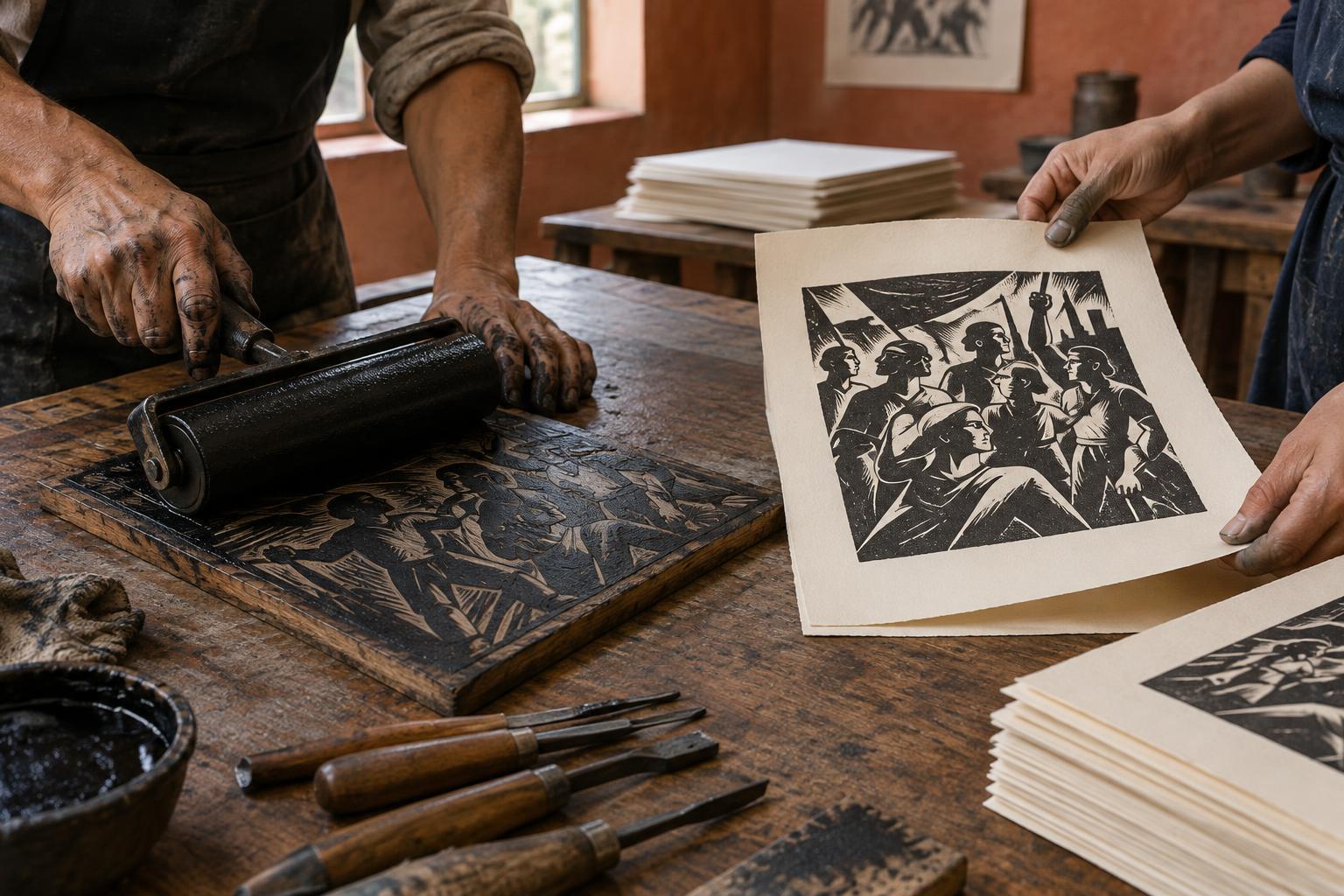
As artists experimented with linoleum in the early twentieth century, its apparent simplicity became an advantage. A carved block can turn a drawing into a pattern of decisive contrasts. Removing material forces choices: a patch of light must be cut away, while a dark shape must stay. Rather than imitate a painting or a wood engraving, artists could make prints that relied on linoleum’s capacity for direct, energetic design.
Bold color and a modern visual language
The Grosvenor School of Modern Art in London became an important center for color linocut in the 1920s and 1930s. Artist and teacher Claude Flight encouraged the medium, and artists associated with the school explored subjects such as movement, work and urban life. Their prints often use simplified forms and strong rhythms. Color is not just added inside an outline; overlapping shapes help build the image.
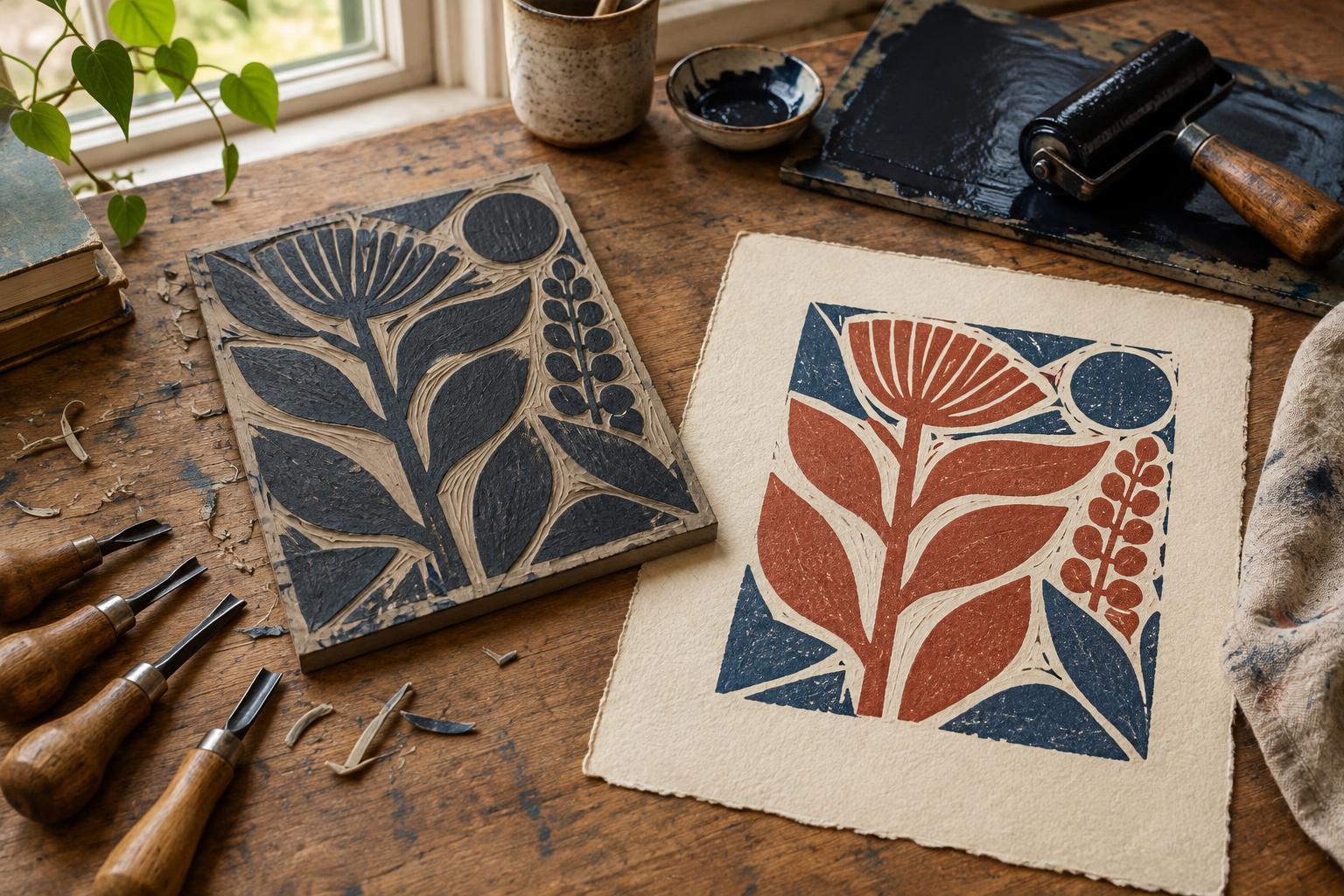
A color linocut may be printed from several blocks, each carrying part of the design. Registering those blocks so the colors meet as intended requires planning and care. Slight variations can also reveal the hand-printing process. These works demonstrated that linocut could support ambitious compositions and complex decisions, even when the finished image looked strikingly economical.
Linocut’s development was not confined to one school or country. Artists working in different places adopted it for their own purposes, from graphic black-and-white images to layered color prints. Pablo Picasso, for example, made inventive color linocuts later in his career. His work helped show how much could be achieved by reworking a block between successive printings, although no single artist can account for the medium’s rise.
What makes a linocut an original print?
A fine-art linocut is not simply a mechanical copy of an existing image. The artist designs and cuts a block for printing, and the decisions made on that block become part of the work. Multiple impressions can be pulled from it, but each impression belongs to a planned edition or printing process rather than being a reproduction of a separate finished artwork.
That distinction helps explain why printmakers pay attention to details beyond the image itself. Ink consistency, pressure, paper and registration can affect each impression. Some artists seek a highly uniform edition; others welcome subtle differences that show how the print was made. An edition number describes the print’s place in a declared group, not a guarantee that every sheet looks identical.
Why its history still matters in the studio
Linocut remains approachable for beginners, but approachability should not be mistaken for a lack of depth. A first project might use one block and one color to explore positive and negative space. A more experienced printmaker might plan several blocks, test transparent ink layers or make a reduction print, carving away more of the same block after each color is printed. In a reduction print, earlier states of the block cannot be recovered, so the edition must be planned before those cuts are made.
The medium’s history offers a useful lesson: artists did not need to disguise linoleum as something more traditional to make compelling prints. They learned from its smooth surface, the resistance of the cutting tool and the clarity of ink on paper. Whether the result is a small study or a carefully editioned color print, the strongest work treats those material choices as part of the image.