A familiar process with new ambitions
Woodcuts were well established before Albrecht Dürer began making them in the late fifteenth century. Printers used carved wooden blocks to reproduce images in books and on separate sheets. The method was practical: the raised surface of a block could be inked and printed alongside movable type. Dürer’s achievement was not to invent the process, but to make its artistic possibilities unusually visible.
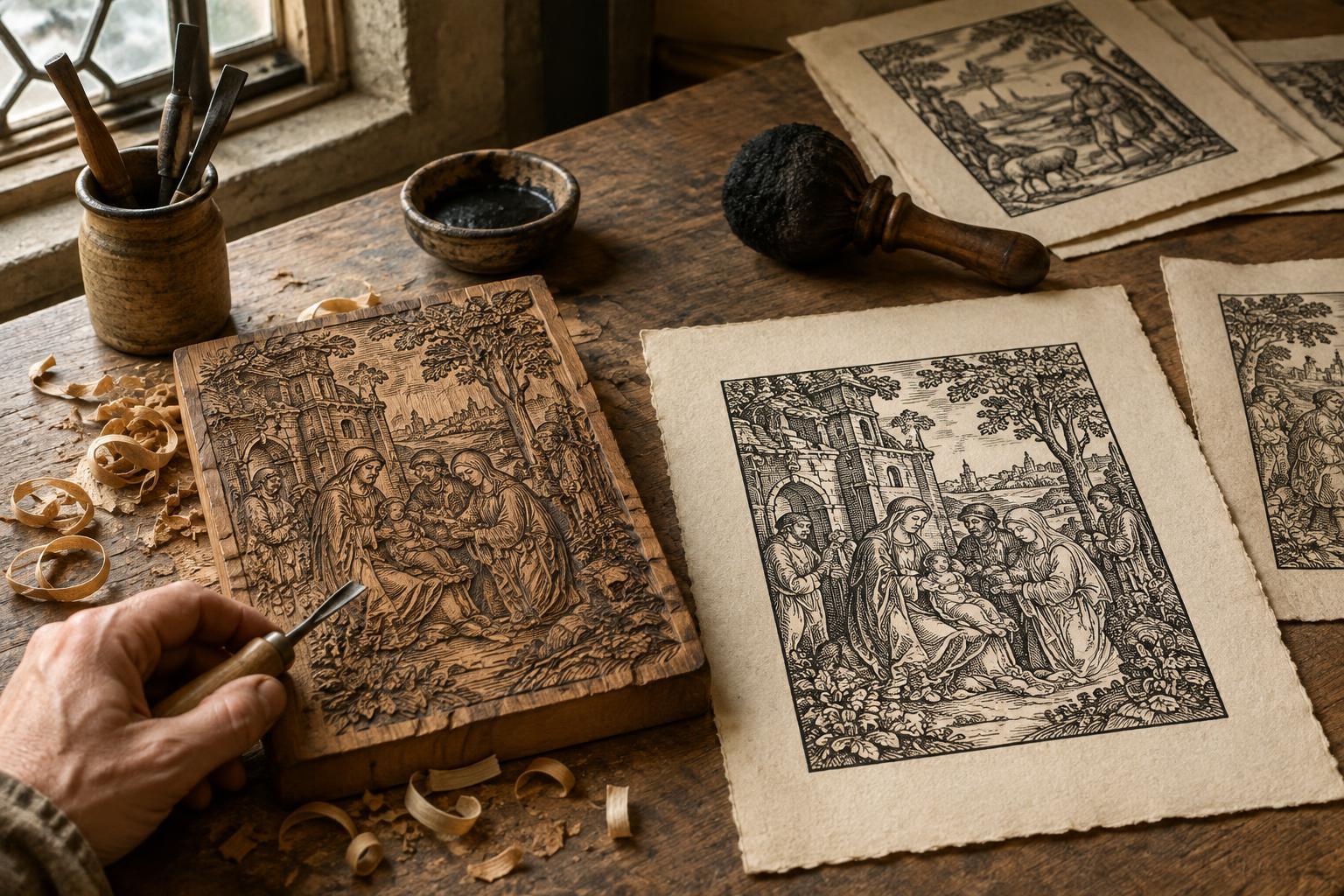
In a woodcut, the parts of the block that remain raised receive ink; the areas cut away print as the color of the paper. This means that a dark line in the finished image must survive as a narrow ridge of wood. Dürer designed images filled with energetic contours, varied marks and dense detail. To understand his contribution, it helps to think of the print as a designed object rather than a drawing that happened to be copied in wood.
Designing for the block
Dürer is often associated with exceptionally fine woodcut lines, but drawing and cutting were not necessarily the same job. Like other artists working with prints, he could create a design for a specialist to cut into the block. The cutter’s skill mattered enormously: a poorly cut block could flatten a lively drawing, while careful cutting could preserve its rhythm. Calling a woodcut “by Dürer” therefore identifies the artistic design and direction without assuming that he carved every line himself.
His compositions made purposeful use of the medium’s constraints. Closely spaced strokes could suggest shadow, while changes in their direction helped describe folds, muscles or turbulent skies. Bold outlines kept figures legible even when a scene was crowded. Look closely at one of his prints and the marks rarely seem evenly distributed: quiet passages of open paper give the eye a rest before it meets another knot of detail.
That balance offers a useful lesson for anyone making a relief print today. Fine lines are appealing, but they need enough space around them to survive carving, inking and printing. A successful design works both at arm’s length, where its main shapes must read clearly, and up close, where smaller marks reward attention.
Stories across multiple prints
Dürer’s woodcuts were not limited to single, self-contained images. His Apocalypse series, published in 1498, presented dramatic scenes from the biblical Book of Revelation. He also developed substantial religious sequences such as the Life of the Virgin and the Large Passion. Across these projects, viewers could encounter familiar subjects as sustained visual narratives rather than isolated illustrations.
A series presents a different design problem from a single print. Each sheet needs enough force to hold attention on its own, yet the images must also feel related. Dürer achieved this through recurring visual concerns: expressive figures, active settings and carefully managed contrasts between dark marks and untouched paper. The scale and arrangement of figures shift from scene to scene, giving each image its own pace while maintaining a recognizable approach.
Printed sheets could reach people who would never see an artist’s original drawing or a painting in its intended setting. That wider circulation was part of the woodcut’s significance. It also gave an artist a reason to plan how work would appear repeatedly, on different sheets of paper and in different hands, rather than treating one finished object as the only result.
What his woodcuts can teach a printmaker
To study Dürer, start with the relationship between dark marks and open space. Choose a reproduction of a woodcut and follow one figure’s outline. Notice where it thickens, where it nearly disappears into surrounding marks and where a pale area of paper makes it readable again. Then step back and ask whether you can still identify the main action. This shift between close looking and distance reveals how much work the composition does.
For a small studio exercise, draw a simple scene using only black shapes, white gaps and a limited number of short strokes. Make one version crowded with detail and another with more open space. You need not imitate Dürer’s subjects or technical refinement; the aim is to test how a design carries information when every mark must be planned for printing.
Dürer’s woodcuts remain compelling because they join invention to a repeatable process. They show that an artist-designed print can be more than a reproduction of another work. The choices made for the block—what to emphasize, what to leave open and how to guide a viewer through a scene—are central to the artwork itself.